
Side Table vs. End Table: Which One Fits Your Couch?
Picking the right furniture for your living room is a mathematical game of inches and utility. You might think a table is just a flat surface for your coffee, but the industry distinguishes between side and end tables for very specific functional reasons. If you buy a piece that doesn’t match the scale of your sofa, you end up with a room that feels physically uncomfortable and visually unbalanced. If you buy a piece that doesn’t match the scale of your sofa, you end up with a room that feels physically uncomfortable and visually unbalanced. You can ensure your seating area feels properly grounded and proportional by pairing 8×10 area rugs with grey sectionals before finalizing your table placement. This guide breaks down the technical data points to ensure you choose the right companion for your seating with the utmost precision. Getting the measurements right for your side tables is a technical win, but to truly ensure your entire space feels intentional, you should follow a comprehensive living room decorating guide that covers everything from lighting to layout
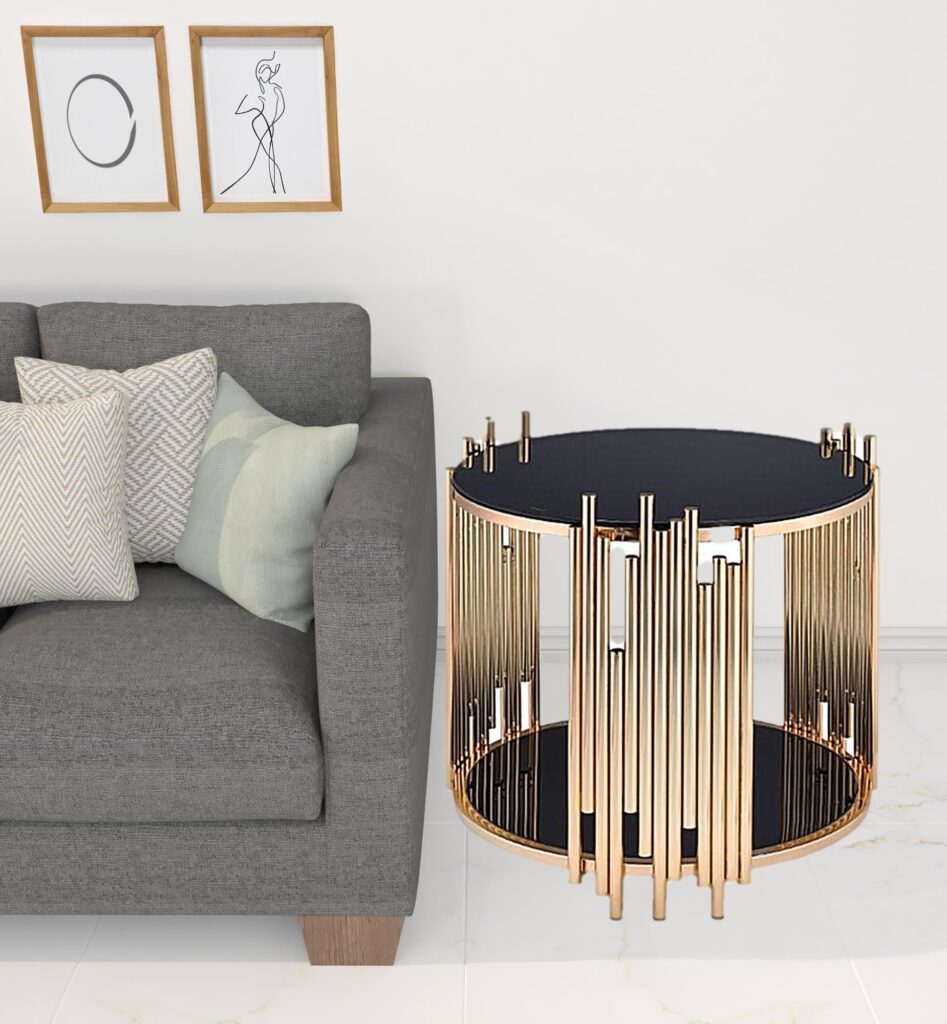
Side Table To Match The Scale Of Your Sofa
– Decorax
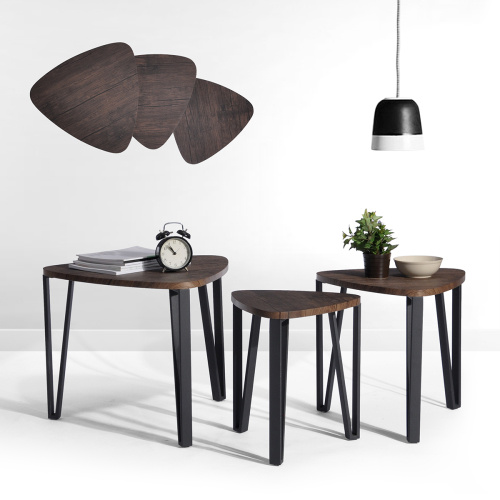
End Table For Your House to Match your Style
– Decoriax
What is the difference between a side table and an end table?
The primary difference between these two pieces is their intended placement and total surface area. End tables are historically designed to sit flush against the arm of a sofa or a chair, functioning as a direct extension of the furniture. Because they are meant to fit into tight corners, their surface area is usually restricted, often measuring between 12 and 18 inches in width.
Side tables, conversely, are standalone pieces that carry more visual weight. They have larger tops and can be placed anywhere in a room, such as against a wall or between two separate lounge chairs. Manufacturers often use these terms interchangeably, but Google’s ranking data suggests that users looking for “side tables” are typically searching for decorative versatility, while “end table” queries focus on specific sofa pairings.
From a design perspective, the end table is a task-oriented tool. Its job is to hold a lamp or a beverage within arm’s reach of a seated person. The side table is more of a stylistic anchor that can house larger decor items like sculptures or oversized books. It often sits in “open” spaces where its larger 18 to 24-inch width won’t obstruct movement.
When you look at your floor plan, consider the “openness” of your seating. If your sofa is boxed in by walls or other furniture, a compact end table is the only logical choice to avoid blocking walking paths. If you have an open-concept room, a larger side table can act as a bridge between your seating area and the rest of the home.
Standard end tables prioritize a slim profile to fit beside deep cushions. Side tables might feature splayed legs or tripod bases that require more floor space to remain stable. The distinction is less about what the table looks like and more about how much floor real estate it consumes in relation to the couch.
Choosing the wrong one often results in a “cluttered” look. If you place a wide side table where a slim end table should be, you lose precious walking space. If you place a tiny end table in a vast open area, it looks structurally insignificant. Matching the table’s footprint to the available gap is the only way to ensure a professional finish.
Can you use a side table as an end table?
You can swap these pieces only if you have accounted for the depth of your sofa frame. A side table is often 20 to 24 inches deep, which can be significantly larger than the side profile of a standard armchair. If the table sticks out past the front of the sofa arm, it breaks the flow of the room and creates a tripping hazard.
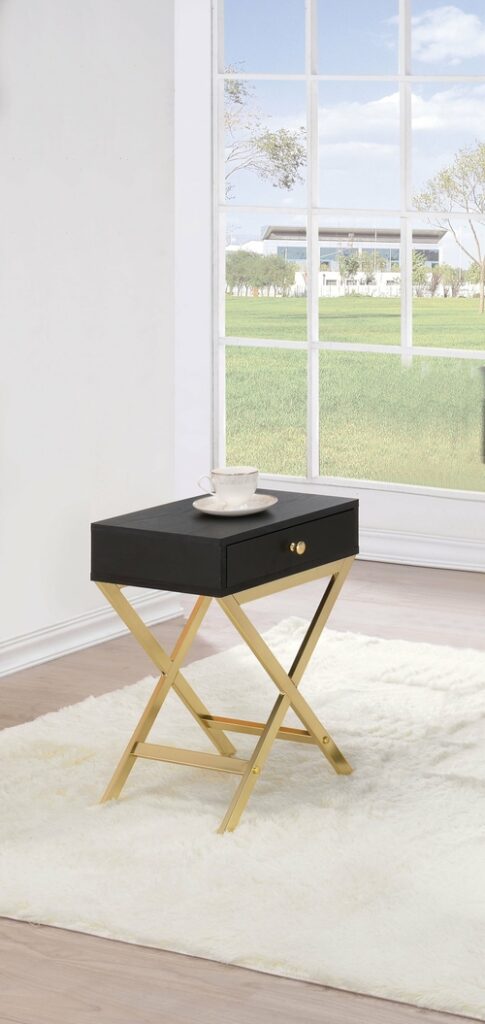
End Table For Make Your House Exquisite!
Interchangeability works best with “open-ended” sofas. If your couch has no arms or very low, modern arms, a larger side table acts as a visual anchor. It provides a larger stage for decor and can even double as a small workspace for a laptop. This makes the furniture work twice as hard for your daily needs.
Measurement of the table’s “footprint” base is as important as the tabletop diameter. Many side tables have decorative pedestals or wide-set legs. Even if the top fits, the base might stick out into the walking path. You must measure the total diagonal width of the base to see if it fits within the nook beside your couch.
Proportion is the final hurdle for this swap. A massive side table next to a dainty, mid-century loveseat will look like an accident. Conversely, a tiny end table next to a deep, overstuffed sectional will look like a toy. Always compare the “visual mass” of the table to the height and bulk of the sofa cushions.
If you do use a side table as an end table, keep the styling minimal. Since the piece is likely larger than a traditional end table, adding too many accessories will make that corner of the room feel heavy. One lamp and one small tray are usually enough to maintain balance.
How tall should an end table be for a sofa?
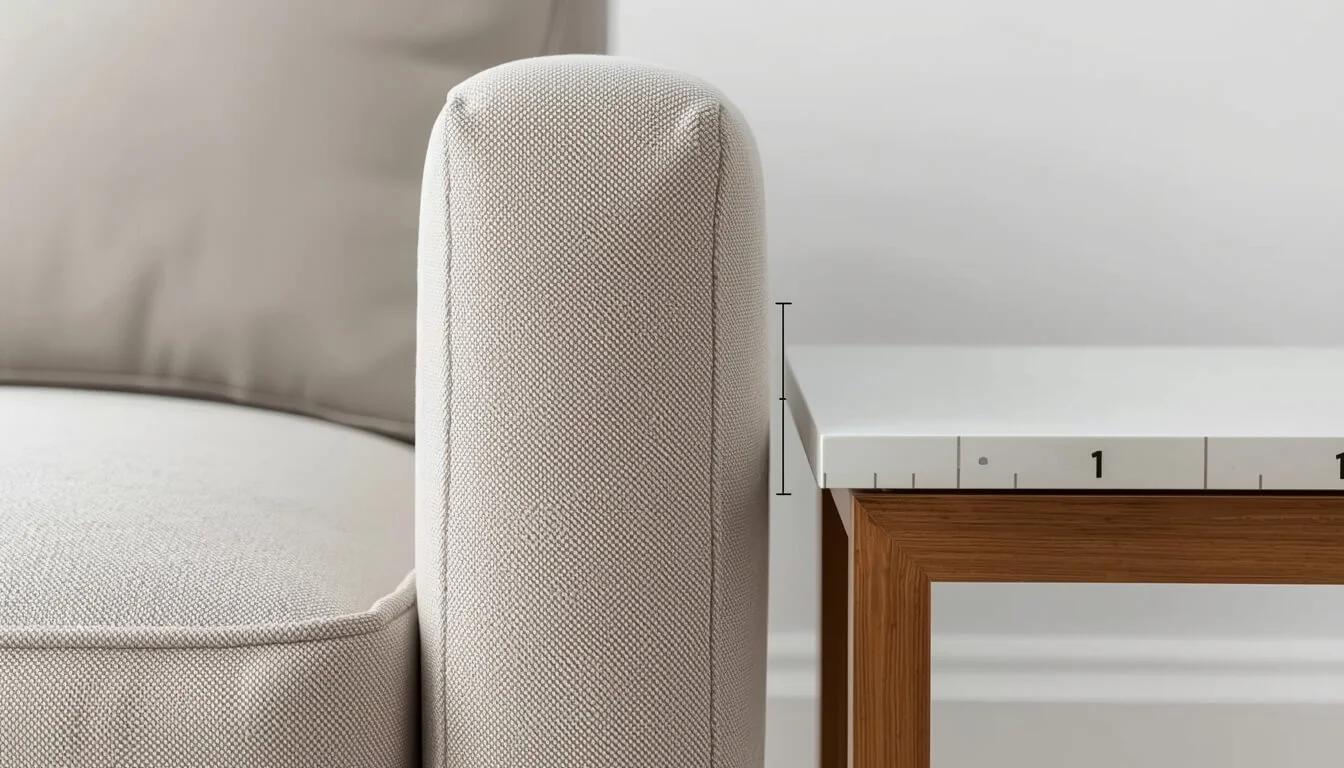
The vertical relationship between your seating and your table surface determines the comfort of the room. The industry standard is known as the “Rule of Two.” This rule states that the top of your table should be within two inches of the height of your sofa’s arm. This ensures that when you reach out for a glass, your arm moves in a natural, horizontal arc.
Standard sofa arms typically measure between 24 and 32 inches from the floor. Consequently, the utmost common target for an end table height is around 25 to 27 inches. Before you purchase, you must measure from the floor to the top of your sofa arm to find your specific “target zone.”
If the table is significantly taller than the armrest, you will find yourself bumping your elbow every time you move. It also creates a physical “box-in” effect that can make a seated person feel trapped. Visually, a tall table next to a shorter couch cuts off the line of sight across the room, making the space feel disjointed.
Ergonomic reach is also a safety factor. If the table is more than 3 inches lower than the sofa arm, you have to lean over and down to set something on it. This shift in center of gravity is how most spills happen. A level surface allows you to maintain eye contact with guests while safely placing a drink.
Proportional symmetry dictates that heavy, substantial sofas require tables with thicker legs to balance the mass. If your couch has a 30-inch armrest, a tiny 20-inch table will disappear visually. The table needs enough “height presence” to stand up to the size of the upholstery it is paired with.
Always account for the “squish” of the cushions. If your sofa arm is soft and sinks when you lean on it, choose a table on the lower end of your 2-inch window. This accounts for the change in your physical height when you are actually using the furniture versus when it is just standing empty.
Standard end table height for modern couches
Modern furniture trends have introduced low-profile “platform” couches that sit closer to the ground. These pieces often have armrests as low as 18 to 22 inches. For these couches, traditional 25-inch end tables look like skyscrapers and ruin the contemporary aesthetic. You must seek out low-slung side tables specifically designed for these proportions.
Matching the horizontal visual plane is a requirement for a modern look. When the table surface aligns perfectly with the low-profile arm, it creates a sleek, continuous line. This draws the eye across the room and makes the ceiling appear higher. It is a simple mathematical trick used by high-end designers to create a sense of luxury.
Low tables for modern couches often feature “C-table” frames. These use 0.5-inch steel tubing to slide under the sofa base. This allows the surface to hover exactly where you need it without requiring a tall, bulky leg structure. It is a unique solution for the specific geometry of low-seated furniture.
If your modern couch has no arms at all, the table height should be based on the seat height. In this case, aim for a table that is 0 to 2 inches higher than the top of the seat cushion. This ensures the table is high enough to be seen but low enough to remain unobtrusive.
Avoid “tall side tables for couch” pairings if your furniture is modern and minimalist. The height mismatch will be the first thing people notice when they walk in. Keeping everything within the same 20-inch height range ensures that the room feels intentionally designed rather than a collection of random parts.
Where to place an end table in a small living room
In a small living room, every square inch of floor space is a premium asset. You must maintain at least 18 inches of clearance between the edge of your table and the coffee table. This “walking lane” is essential for natural movement. If you can’t walk through your room without turning sideways, your tables are too large.
Corner placement in sectionals is a common strategy, but it requires a specific shape. A circular side table is often better for these tight spots because it eliminates sharp-edge hazards. In a small room, people are more likely to brush against furniture; a round edge prevents painful bumps and keeps the “flow” of the room soft.
Visual “weight” is a critical data point for small spaces. Tables with glass tops or thin metal legs allow the eye to travel through the piece to the floor and walls. This creates the illusion of a larger area. Solid wood block tables or drum-style tables consume a lot of “visual volume,” which can make a small room feel claustrophobic.
If you have a very narrow room, consider placing the table slightly behind the sofa arm rather than directly beside it. This “staggered” placement keeps the front of the sofa open and makes the seating area feel wider. It also allows you to use a slightly larger table than a side-by-side arrangement would permit.
Small side tables for sofas should be multi-functional. Look for pieces with a small drawer or a lower shelf. This allows you to clear the top surface of clutter like remotes and magazines, which is vital for keeping a small room looking organized. A clean surface always makes a room feel more spacious.
Always check the “swing” of nearby doors. It sounds simple, but many homeowners forget that a door needs 36 inches of clearance. If your end table sits in the arc of a door or a cabinet, it will eventually be damaged. Map out your floor plan with tape before buying to ensure the piece doesn’t interfere with the room’s mechanics.
Modern nesting side tables: The Space-Saving Solution
Nesting tables are a mathematical solution for multi-functional rooms. These sets allow you to stack two or three surfaces within the footprint of a single table. When you are alone, you keep them tucked away; when you have guests, you can expand them to provide 2.5 times the surface area. This unique flexibility is why they are a staple in professional apartment design.
The engineering of modern nesting tables often uses 0.5-inch steel tubing. This provides the utmost stability with the least amount of material. Because the legs are so thin, they don’t block light or floor patterns. This makes them appear almost invisible when tucked away, preserving the “open” feel of your living room.
Nesting tables also allow for tiered heights. This is useful for separating tasks; you can keep a lamp on the tallest table and use the lower, pulled-out table for a laptop or a dinner plate. This vertical separation keeps your “work” space and “relax” space distinct, even if they are only inches apart.
When buying nesting tables, check the “slide” mechanism. High-quality sets feature felt or rubber bumpers on the underside to prevent the smaller tables from scratching the larger ones. Since these pieces will be moved frequently, the durability of the joints and the finish is paramount.
They also offer a great way to introduce a “set” without it feeling forced. Since the tables vary in size, they provide a natural, staggered look that feels more organic than two identical end tables. This subtle variety is a hallmark of high-end, curated interior design.
Functional Aesthetics: Accent table vs end table
While an end table is defined by its position, an accent table is defined by its material and visual impact. An accent table is “room jewelry.” Its primary job is to provide a unique texture or a pop of color—like marble, agate, or brass—rather than just serving a utilitarian purpose.
The weight limit is the biggest technical difference. A standard wood end table can easily support 50-100 lbs, which is enough for a large lamp and a stack of heavy books. Many decorative accent tables are only rated for 15-20 lbs. If you plan to use the table for a heavy designer lamp, you must verify the weight capacity to avoid structural failure.
Mixing materials is a professional trick to avoid the “showroom-stiff” look. If you have a wooden coffee table, choosing a metal or stone end table breaks the visual monotony. This makes the room feel like it was built over time rather than bought all at once. It adds depth and a sense of “soul” to the environment.
Accent tables are often used as conversation pieces. They might have a geometric base or be made from an unconventional material like reclaimed sea glass or hammered copper. These pieces work best when they are placed in a spot where they can be seen from all sides, making them excellent candidates for “side table” roles.
However, don’t sacrifice function for form. An accent table still needs to be at a reachable height. Even the most beautiful marble pedestal is useless if it sits 10 inches below your sofa arm. Always apply the “Rule of Two” to your accent pieces to ensure they stay as useful as they are beautiful.
In a high-traffic home with kids or pets, be wary of top-heavy accent tables. Narrow pedestals with wide tops are prone to tipping. For these environments, stick to traditional four-legged end tables for the utmost safety and durability. Save the delicate accent pieces for lower-traffic areas like a reading nook.
End tables for living room set integration
If you decide to buy a matching living room set, you are guaranteed a cohesive look, but you risk a lack of personality. The key to making a set work is in the accessories. Use different textures on each table—a ceramic lamp on one and a metal tray on the other—to create a “mismatched” feel within the matching framework.
Matching sets are mathematically efficient. They are designed to fit together in terms of height and style, which takes the guesswork out of the process. If you aren’t confident in your ability to mix wood grains or metal finishes, a set is a safe way to ensure your room looks balanced.
However, consider the scale. Sometimes sets are designed for large suburban homes and the end tables are too wide for urban apartments. Always check the individual dimensions of every piece in the set, not just the coffee table. The end tables are usually the first things to get cut if the room feels too full.
If your set feels too “heavy,” you can split it up. Use one end table in the living room and move the other to a bedroom to act as a nightstand. This spreads the aesthetic throughout your home and prevents the living room from feeling like a furniture catalog page.
Curated sets often include a “coordinated” rather than “matching” look. This means the tables might have the same leg design but different top materials. This is the “gold standard” for professional sets because it provides the cohesion of a set with the visual interest of individual pieces.
Material Science and Technical Durability
The longevity of your table is determined by the Janka hardness rating of the wood. Solid oak, maple, and walnut have high ratings, meaning they resist the scratches and dings of daily life. If you have a busy household, investing in these hardwoods is a necessity. Engineered wood or MDF tables are more affordable but cannot be repaired once the surface is gouged.
Thermal expansion is a factor that often ruins cheap furniture. Solid wood reacts to changes in humidity, which can cause joints to crack if they are glued too tightly. High-end tables use “floating” joinery techniques that allow the wood to move naturally. This technical detail is what separates a table that lasts five years from one that lasts fifty.
UV-resistant finishes are required for any table placed near a window. Constant sunlight will fade the stain on wood or turn clear acrylic yellow over time. Check the manufacturer’s specs for “UV-inhibitors” in the lacquer. This ensures your furniture maintains its original color for the utmost amount of time.
Modern end tables are increasingly incorporating built-in technology. Features like USB-C ports and wireless charging pads are now standard in professional-grade furniture. For someone who works from the couch, these features increase the utility of the table by 40% by eliminating the need for long, messy charging cords across the floor.
If you use your table for drinks, the finish type is the most important data point. A “water-borne” finish is environmentally friendly but can be sensitive to moisture. A “polyurethane” or “conversion varnish” finish provides a hard, plastic-like barrier that is almost impervious to water rings. Always use a coaster, but a strong finish is your second line of defense.
Metal tables should be powder-coated rather than just painted. Powder-coating is a process where dry powder is baked onto the metal, creating a finish that is much harder and more resistant to chipping than standard spray paint. This is especially important for the base of the table, which will likely be hit by vacuum cleaners and shoes.
Stone tops, like marble or granite, provide a luxury feel but come with maintenance requirements. Marble is “acid-sensitive,” meaning a drop of lemon juice or wine will “etch” the surface, leaving a permanent dull spot. If you want the look of stone without the stress, look for “quartz” or “porcelain” tops, which are engineered to be non-porous and stain-resistant.
The Reach Test: Final Criteria for Side vs. End Table Selection
To wrap up, picking between a side table and an end table isn’t just a style choice—it’s a measurement task. Start by measuring your sofa arm height and aim for a table within a 2-inch window of that number. This ensures ergonomic comfort and a clean visual line. Then, check your depth; a table should never stick out past the front of your couch arm.
Maintain the 18-inch clearance rule to keep your walkways open. If you are short on space, nesting tables or cantilevered C-tables offer a unique way to get utility without clutter. These pieces provide the utmost flexibility for modern living, allowing your room to adapt to different needs throughout the day.
Don’t forget the technical specs. Check for hardwood durability, UV-resistant finishes, and weight limits to ensure your furniture lasts as long as your home. Whether you choose a decorative accent table or a task-heavy end table, grounding your decision in these facts will result in a professional, well-designed space.
The final checklist for any buyer:
- Is it within 2 inches of the arm height?
- Is the depth equal to or less than the sofa?
- Is there an 18-inch walking path?
- Does the material match my lifestyle (kids, pets, coffee)?
By checking these boxes, you transform your living room from a collection of furniture into a mathematically balanced environment that truly fits your life.
The distinction is based on footprint and placement. End tables are task-oriented, sitting flush against a sofa arm with a slim 12–18 inch width. Side tables are standalone decorative anchors, often larger (18–24 inches wide), and can be placed away from the sofa against walls or between chairs.
Following the “Rule of Two,” an end table should be within 2 inches of the sofa arm height. For a standard 25-inch armrest, the table should stay between 23 and 27 inches. This height range maintains ergonomic reach and prevents physical strain or visual imbalance.
Yes, provided you measure the sofa frame depth. A side table is often 20–24 inches deep. If this exceeds the depth of your sofa arm, the table will protrude into the room’s walking path, creating a tripping hazard. It works best with “open-ended” or armless sofas.
Modern platform couches often feature armrests between 18 and 22 inches. For these pieces, you must avoid standard 25-inch tables and instead opt for low-slung side tables or cantilevered C-tables to preserve the room’s horizontal visual plane.
No. An accent table prioritizes unique materials (marble, brass, agate) over load-bearing utility. While an end table is built to support 50–100 lbs (like heavy lamps), many accent tables are decorative and only support 15–20 lbs.