
A beautifully designed floor lamp can be the punctuation mark of a reading nook’s decor, and the glow it gives off can transform a sad corner into the most inviting space in your home. The only way to know if a lamp works as it should is to touch it, build it, turn it on and off, and live with it. That is exactly what we did with dozens of fixtures in our homes and offices, evaluating how they handle real-world challenges like tippy bases, hard-to-reach switches, and loose hinges.
When you are setting up a dedicated reading space, your lighting choices shouldn’t be based purely on aesthetics or how nice the hardware looks when unlit. A truly successful setup relies on a deliberate balance of physical stability, precise spatial measurements, and soft illumination that stops eye strain before it starts. Through years of hands-on testing, we have found that the best floor lamps for reading nooks share a few non-negotiable traits that separate a frustration-free lounge space from a sad, dark corner.
Our Core Testing Pillars
- Physical Stability: The fixture must feature a heavily weighted iron, marble, or stone foundation that holds its ground against accidental bumps.
- Layout Footprint: The base and arm extension must fit cleanly into tight corner spaces without obstructing foot traffic lanes or hanging too low.
- Light Diffusion: The shade architecture must direct illumination precisely onto the page while shielding your eyes from the raw heat of the bulb.
To prove a lamp base is actually stable, real safety testers use a simple ‘ramp test.’ They extend the lamp all the way out and place it on a steep 15-degree hill. During these engineering safety assessments, a high-performance reading base must pass a strict 15-degree lateral tip tilt angle threshold to guarantee it balances perfectly and won’t topple if stepped on in the dark. If it falls, the base is too light to survive a busy living room.
1. Dial In the Ideal Shade Height
Finding the correct vertical placement for your light source is the most crucial step in preventing blinding glare and maintaining text clarity over hours of focus. When you settle into your favorite seat, the lower rim of the lamp shade should align horizontally with your eye level rather than sitting above or below it. Keeping this boundary resting between 39 and 49 inches from the floor effectively blocks the bare bulb from shining directly into your retinas while concentrating a dense beam onto your pages. To completely eliminate page squinting, ensure your fixture outputs between 450 and 500 lumens, which provides a crisp, focused field without washing out the paper texture. If a fixture sits too high, you will find yourself constantly dodging the exposed socket, while a fixture that sits too low clips the light beam and cuts your usable reading area in half.
Shade Alignment Boundaries by Seating Profile
| Seating Profile Type | Seated Eye Level Baseline | Optimal Shade Lower Rim | Tester Notes & Glare Prevention |
| Low Modern Lounge | 36 to 40 Inches | 39 to 41 Inches | Perfect for low-slung sling chairs; forces the beam down to eliminate background room contrast. |
| Standard Armchair | 42 to 46 Inches | 43 to 45 Inches | Matches most classic wingbacks; ensures the shadow of your own head doesn’t block the text. |
| Deep Chesterfield Recliner | 47 to 50 Inches | 48 to 49 Inches | Requires a taller pole presence; keeps the light source clear of the chair’s thick rolled arms. |
2. Lock in a Warm Color Temperature
The physical properties of your light bulb dictate how long you can read before your eyes begin to blur or feel dry. The best bulb color temperature for reading at night centers precisely at 2700K, which emits a soft, amber-toned warm white light. This specific spectrum mimics natural flame tones, signaling to your brain that it is time to unwind while providing high-contrast illumination for printed words. Pairing this temperature with a 90+ CRI (Color Rendering Index) rating guarantees that contrast boundaries between black ink and off-white paper remain completely distinct.
Avoid installing cool 4000K or 5000K daylight bulbs in your evening relaxation spaces. These harsh, blue-tinted waves stimulate daytime cortisol production, which tricks your body into staying alert and can severely disrupt your natural sleep cycle.
Here’s a secret: most book paper is treated with chemicals to make it look super bright white. When you shine a harsh blue ‘daylight’ bulb on it, the paper bounces that blue light right back into your eyes like a tiny mirror, causing a huge amount of invisible glare. A warm 2700K bulb doesn’t have that blue spike, so the pages stay soft and easy to read.
Evening Illumination Progression:
[Late Afternoon Sun] ──> [Task Light Activation (2700K)] ──> [Melatonin Release Enabled]
Nighttime Visual Mechanics
- Blue-Light Suppression: Utilizing a strict 2700K warm source reduces short-wavelength light exposure, protecting your circadian rhythm before bed.
- Contrast Balancing: High-performance task setups deliver sharp focus on white paper or ink, allowing your optic muscles to relax without squinting.
- Perimeter Softening: Keeping background brightness low prevents your pupils from constantly dilating and contracting as you look up from your book.
3. Deploy an Adjustable Pharmacy Lamp
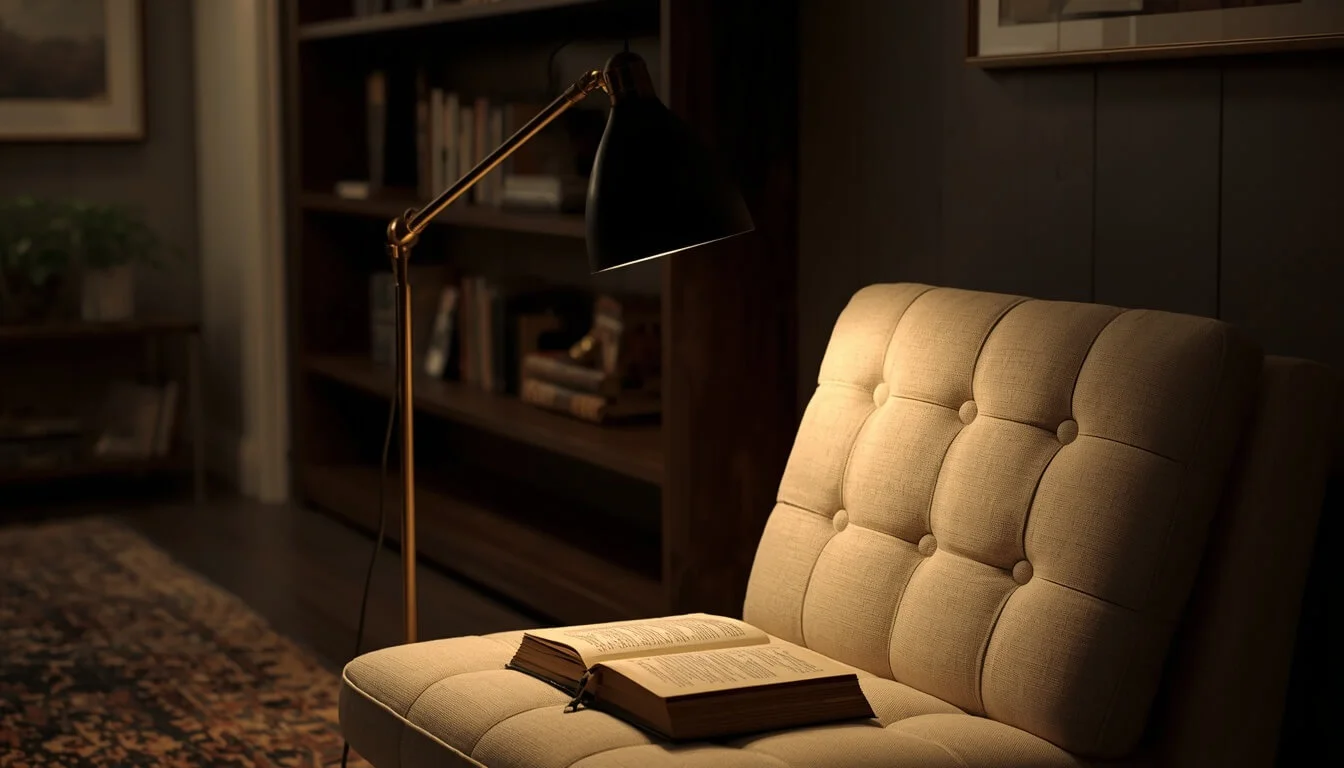
When floor space is limited, adjustable pharmacy floor lamps are the ultimate low-profile task champions. These vintage-inspired fixtures combine an incredibly compact, heavy iron base with a thin metal column that slides easily between an armchair and a wall. Their true power lies in their articulated mechanical hinges, which let you pivot the solid metal shade both horizontally and vertically. You can lower the physical light source all the way down to 36 inches, generating an ultra-focused cone of light that completely isolates your page from the rest of the room. This structural metal shielding forces the light waves into a concentrated 30-degree to 50-degree directional beam spread, dropping shadows away from your hands entirely.
- Footprint Efficiency: The flat, circular base typically measures under 10 inches in diameter, letting it slip behind the tightest leg frames.
- Zero Glare Head: Solid metal shades block all lateral light escape, ensuring that the illumination goes strictly onto your book and nowhere else.
- Mechanical Longevity: High-grade versions use solid brass compression joints that hold their position over decades of daily adjustment without slipping down.
- Seating Compatibility: Excellent for low-back Scandinavian lounge chairs where a standard tall floor lamp would tower awkwardly over the frame.
When NOT to choose this style: Avoid a pharmacy lamp if your armchair features thick, overstuffed rolled arms. Because these columns are completely straight and have a short physical reach, the metal shade will hit the outside armrest before the light can ever reach your lap. For deep, bulky seating, an arc lamp is always a better choice.
4. Solve Awkward Angles with an Arc Lamp
Using arched floor lamps for reading chairs solves a classic spatial puzzle: how to get light directly overhead when you cannot place a traditional lamp base behind your seat. If your armchair rests flat against a wall or sits dead-center in an open living room layout, a straight-pole lamp can force you to sit at an awkward angle to avoid casting your own shadow on your book. An arc lamp completely bypasses this issue by rooting its heavy foundation several feet away and sweeping a long, dramatic arm gracefully over the furniture frame.
The sweeping metal arm should project the dome shade exactly 12 inches forward from the back of the seat cushions to clear your head space. This positioning drops clean, glare-free light straight down onto your lap, creating an intimate, self-contained oasis inside an open room layout.
Watch out for structural neck sag over time. Because a long, heavy metal arm acts as a lever against a distant base, low-grade steel frames will slowly bend down under continuous gravity stress, dropping the heavy dome head by several inches over a few years of use. To avoid this, look for fixtures made with thick, tapered metal tubing or internal counterbalancing springs that hold their precise shape.
Tester’s Spatial Warning: Arc lamps are architectural heavyweights that demand rooms with high ceilings. Never attempt to jam a large arc lamp into a space with low ceilings (under 8 feet), or you will find yourself constantly ducking under the shade whenever you get up from your chair.
5. Clear Out the Corner Footprint
Optimizing where to place a floor lamp in a small reading corner requires evaluating the dance between your physical furniture and the architecture of the walls. Many people reflexively push their armchair deep into the corner angle and try to cram a lamp directly behind it, which jams the cord against the baseboard and makes the switch impossible to reach. Instead, pull your chair forward about 6 inches and slide slim-profile black and brass reading lamps onto the side opposite your dominant hand.
Placing the fixture on your non-dominant side ensures that your arm will never cast a shadow across the page as you reach up to turn it. This simple layout adjustment keeps your high-traffic walking lanes clear while creating an elegant visual anchor for the entire corner.
[Wall Corner]
  │   ↖ (6-inch air gap)
  │  [Black and Brass Lamp Base]
  └───  [Non-Dominant Side]
         [Reading Armchair] ──> (Dominant Hand Free of Shadows)
Corner Placement Metrics
- Wall Clearance: Maintain a 4-inch gap between the metal pole and the drywall to prevent raw hardware from vibrating against the baseboards.
- Switch Access: Position the inline foot switch clear of the armchair’s feet so you can tap it easily without reaching blindly into the dark.
- Cord Camouflage: Route the power line flat along the baseboard molding using clear adhesive clips to keep the floor looking tidy and trip-free.
6. Use Tripod Styles for Double Duty
Modern tripod floor lamps for corners offer stunning architectural style, but their wide stance demands plenty of room to breathe. Unlike slim rod lamps, a tripod base uses three splayed legs that require a minimum layout footprint clearance of 24 inches to avoid turning into a constant tripping hazard.
Because these fixtures are almost always topped with traditional fabric drum shades, they behave differently than focused task lights. They diffuse soft, warm illumination outward in a wide circle, making them the perfect choice for readers who want to blend background ambiance with focused utility.
The splayed legs act as a natural structural anchor that keeps the fixture from tipping over if it gets bumped by pets or children. However, because the fabric shade allows light to bleed into the surrounding room, you will want to choose a dense, textured weave to keep the brightness from washing out your TV screen or casting harsh reflections across the rest of the space.
The Hard Trade-off: Never place a tripod lamp on a thick, plush rug directly next to a walkway. The splayed wooden or metal legs easily catch on loose socks or pet collars, and because tripod frames carry their weight higher up than a solid iron flat base, they tip over with very little effort if clipped by a foot.
Tripod Footprint Requirements:
   / \
  /   \  <─── Requires a full 24-inch floor spread to maintain center-gravity balance.
 /     \
Tripod Technical Specifications
- Base Spread Diameter: Requires a 24-inch to 28-inch triangular clearing on the rug surface.
- Material Strength: Hardwood or tubular steel legs offer the highest resistance against structural bowing over time.
- Wobble-Test Rating: High center-of-gravity stability makes these fixtures excellent for open carpet layouts.
- Shadow Profiling: Broad drum shades soften perimeter room contrast, reducing night-time eye fatigue.
7. Step Up Control with Dimmable LEDs
Integrating dimmable LED floor lamps for living rooms gives you complete control over your environment as natural daylight shifts from afternoon to late night. Instead of being stuck with a single, aggressive brightness level, a smooth dimming system lets you crank the output up on gloomy winter days or dial it back to a soft, warm hum before bed.
Look for fixtures that feature a heavy, built-in slider switch right on the pole or an easy-to-use foot pedal. This ensures you can adjust the light output without having to clumsily twist a tiny plastic dial right next to a hot bulb while trying to relax.
Dimming Options Matrix
- Built-In Sliders: Offers infinite, step-free adjustments from 10% to 100% brightness, allowing you to match the room’s changing ambient light perfectly.
- Three-Way Foot Pedals: Provides quick, click-stop changes between preset low, medium, and high outputs, though it lacks the fine control of a slider.
- Smart Plug Integrations: Lets you connect a standard lamp to your phone or voice assistant, but cheaper LED bulbs can buzz or flicker when dimmed through external outlets.
- Integrated Diodes: Offers incredible energy savings and slim designs, but if the built-in light board ever fails, the entire lamp usually has to be replaced.
This annoying buzzing or flickering usually happens because cheap dimmers act like a super-fast strobe light. Instead of smoothly lowering the electricity, they turn the light completely on and off thousands of times a second. It happens so fast that your eyes can’t see the flashing, but your eye muscles still feel it and get tired. When shopping, look for high-quality dimmable fixtures that smoothly turn down the power line instead of chopping it up.
Quick Buying Decision Framework
| If Your Goal Is To… | Choose This Style… | Because It Offers… | Avoid This Style… |
| Read for hours without disturbing a partner sleeping nearby. | Pharmacy or Task Lamp | A solid metal shade that locks light into a tight, narrow 30-degree beam. | Tripod or Fabric Drum Lamps |
| Bring general, cozy warmth to a cold living room corner. | Tripod with Fabric Shade | Wide, 360-degree ambient diffusion that bounces light off walls. | Pharmacy Task Lamps |
| Light an armchair that is pushed flat against a back wall. | Arched or Arc Lamp | A long, sweeping neck that brings the bulb overhead from a distance. | Straight Rod Lamps |
Hardware Care & Long-Term Mechanical Testing
Living with a fixture over multiple years reveals structural weaknesses that a simple unboxing review completely misses. Heavy daily adjustment causes standard friction-fit joints to drift, requiring you to tighten the internal hex compression screws every six to twelve months to keep the metal arm from slowly dropping down. Additionally, deep metallic dome shades behave like dust traps; a heavy build-up inside the reflector cone can degrade your total light output by up to 15% over time. To ensure your lighting performance remains constant, wipe down the cold inner socket housing with a dry microfiber cloth during your seasonal cleaning schedule.
The Reality of “Lookalike” Lighting
If you spend any time shopping for lighting online, you will quickly notice that lamps priced under $150 often look identical to designer fixtures that cost ten times as much. This happens because mass-market retailers frequently buy off-the-shelf, ready-made designs from the exact same overseas factories, adding minor adjustments before slapping on their own brand names.
While a budget-friendly replica can look fantastic from across the room, the real differences show up in the hidden details of the construction. Premium lighting brands justify their high price tags by using heavy, solid metals, pristine glass work, and custom-engineered parts that prevent wear and tear.
Most cheap replicas cut production costs by using low-grade, cast zinc alloys—often called ‘pot metal’—hidden inside their hinges and base weights. This cheap metal mix is incredibly brittle and forms tiny microscopic cracks under daily stress, while their shiny gold or chrome looks come from a quick, ultra-thin chemical flash plating rather than a true, durable baked powder coating. Over time, simple hand oils or damp dusting cloths will eat right through this thin layer, causing the metal to flake off, rust, and look dull.
If you are shopping on a tight budget, look for simple, honest designs like matte-powder-coated steel or basic industrial utility lights. These budget-friendly options don’t rely on expensive finishes to look great, giving you excellent reliability and style without breaking the bank.
An adjustable pharmacy lamp or a slim rod lamp placed on your non-dominant side works best for small reading corners. Pharmacy lamps feature flat, compact bases under 10 inches in diameter that slip easily behind tight chair frames, while their solid metal shades concentrate light into a narrow beam without bleeding brightness into the rest of the room.
For a standard armchair, the lower rim of the lamp shade should align horizontally with your seated eye level, resting between 43 and 45 inches from the floor. Keeping the shade boundary at this height blocks the bare bulb from shining directly into your eyes while focusing a dense field of light onto your book pages.
A warm white color temperature of 2700K paired with a 90+ CRI (Color Rendering Index) rating is ideal for evening reading. This amber-toned spectrum mimics natural flame tones to protect your circadian rhythm, while high color rendering ensures printed black ink boundaries remain distinct against off-white book pages without creating blinding glare.
Place the floor lamp about 6 inches behind or directly beside your chair on the side opposite your dominant hand. Positioning the fixture on your non-dominant side ensures that your arm and shoulder will never cast a shadow across the page as you reach up, take notes, or turn pages.
Yes, arc lamps are excellent for reading chairs when you cannot place a traditional lamp base directly behind your seat, such as when a chair sits flat against a back wall. The sweeping metal arm allows the base to sit several feet away while projecting the shade overhead to drop clean, glare-free light straight down onto your lap.
Dimmable LED lamps only cause eye strain if they use cheap dimming systems that rapidly flash the light on and off to lower brightness. While this strobe effect happens too fast for your eyes to see consciously, your eye muscles still constantly contract and fatigue; always look for high-quality dimmers that smoothly lower the continuous electric current instead.