
Stop the ‘Floating Sofa’ Look: The 5-Step Formula for Pairing 8×10 Area Rugs with Grey Sectionals
Walking into a living room with a bare floor and a grey sectional is like looking at a beautiful painting that is missing its frame. It feels unfinished. The grey sectional is the “old reliable” of the interior design world. It is sturdy, forgiving of spills, and endlessly versatile. However, without the right foundation, that large piece of furniture can look like a lonely island floating in a sea of floorboards. To ensure your space feels like a home rather than a furniture showroom, you need the right rug. While getting the rug right is a major win, it is only one piece of a much larger puzzle found in our unique living room decorating guide designed to help you build a cohesive home.
Choosing 8×10 area rugs for grey sectional sofas is a strategic move that balances scale and comfort. In the current market, sectionals account for nearly 55% of all living room sofa sales. This shift toward larger seating means the old 5×7 rug just won’t cut it anymore. An 8×10 rug covers exactly 80 square feet. This is the “Golden Ratio” for a standard 12×18 living room. It provides enough surface area to ground your furniture while still showing off a bit of your hardwood or stone flooring.
Are you worried that your room feels a bit “drab”? You are not alone. Many homeowners pick a grey sofa because it is safe, only to find the room feels cold. The right rug adds that unique layer of soul that a solid piece of upholstery lacks. It is about more than just covering the floor; it is about creating a “zone” for conversation, relaxation, and the occasional nap. We want to move away from the “catalog” look and move closer to a space that feels gathered over time.
Think of your rug as the glue of the room. It brings the wall color, the sofa fabric, and your coffee table books into one cohesive story. This balance is further improved by choosing a side table to match the scale of your sofa, which prevents the seating area from feeling cluttered or unfinished. This guide will help you treat your living room with the utmost care, focusing on facts rather than fluff. We are going to look at layout, materials, and color pairings that actually work in real homes. Whether you have a tiny flat or a sprawling country house, the math of design stays the same.
Mastering the Layout: Large Area Rugs for L-Shaped Sectionals
When you have a massive L-shaped piece of furniture, the layout becomes a game of physics. If the rug is too small, the sectional looks like it is swallowing the room. If it is too big, the room feels like one giant carpeted box. This is why large area rugs for L-shaped sectionals are the industry standard. An 8×10 rug is usually 120 inches long. Since most standard sectionals are between 90 and 100 inches long, this size provides a 10-to-15-inch border of rug on either side of the sofa.
Key Takeaways for Layout & Scale:
- The 6-Inch Rule: To create a stable visual environment, at least 6 inches of the rug should sit under all sides of the sectional. This anchors the piece and prevents “rug creep.”
- The Golden Ratio: For a living room that is 216 square feet (standard 12×18), an 80-square-foot rug (8×10) covers 37% of the floor, which is the mathematically ideal ratio for balance.
- Traffic Flow: Leaving 18 inches of “bare floor” around the rug edges is the standard for comfortable walking paths in a residential setting.
There is a hard rule in design: the “All Legs on” rule. To create a stable visual environment, you should have at least the front legs of every piece of furniture sitting on the rug. Ideally, with a sectional, you want at least 6 inches of the rug to sit under the sofa. This prevents the rug from sliding and creates a unified “seating island.” It also stops the rug from curling up at the edges when someone sits down heavily.
Why does this matter for your daily life? A rug that is properly tucked under a sectional stays flat. It won’t become a tripping hazard for kids or pets. If the rug is just “touching” the edge of the sofa, it looks like an afterthought. You want the sofa to feel “anchored” to the floor. By placing the “crook” of the L-shape directly over the rug, you define the boundaries of the living area. This is especially important in open-plan homes where the living room, dining room, and kitchen all bleed into one another.
Don’t be afraid if things aren’t perfectly centered. In a classic British-style living room, a bit of asymmetry is a sign of life. Maybe your rug sits a bit further to the left to accommodate a fireplace. That is fine. As long as the sectional is grounded, the room will feel balanced. The goal is to provide a soft landing for your feet the moment you stand up from the sofa. If your feet hit cold floorboards first, your rug is in the wrong spot.
Measure your floor twice before you buy. Use painter’s tape to mark out an 8×10 rectangle on your floor. Then, move your sectional into place. If the tape disappears completely under the sofa, the rug might be too small for the “all legs on” look, but perfect for the “front legs only” style. This simple tape trick saves you the headache of a return shipment. It is the easiest way to visualize how much floor space you will actually have left for walking paths. Using large area rugs for L-shaped sectionals requires this level of planning to avoid a cramped feeling.
Material Science: Wool vs. Synthetic 8×10 Rugs for High Traffic
Let’s talk about the “muddy welly” factor. If you live a real life—one with dogs, children, and red wine—the material of your rug is more important than the pattern. While your flooring needs to be resilient, your seating should be equally prepared for the ‘muddy welly’ factor; understanding the technical rules for pet friendly sofa fabrics will help you choose upholstery that is as durable and easy to clean as your rug. You are likely choosing between Wool vs. Synthetic 8×10 rugs for high traffic. Both have their place, but they behave very differently over time. Wool is the “estate antique” of rug materials. It has been used for centuries because it is incredibly resilient.
Key Takeaways for Materials:
- Stain Resistance: Natural wool contains lanolin, a waxy coating that makes it 30% more stain-resistant than untreated nylon or polyester.
- Fiber Memory: Heat-set polypropylene (synthetic) has a high “recovery rate,” meaning it can withstand up to 50 lbs per square inch before the fibers permanently flatten.
- Flammability: Wool is naturally flame-retardant and will self-extinguish, whereas synthetic rugs can melt or carry a flame more easily.
- Lifespan: A high-quality wool rug has an average lifespan of 50+ years, while a standard synthetic rug usually lasts 5 to 7 years in a high-traffic zone.
The secret to wool is lanolin. This is a natural, waxy coating on the sheep’s wool that acts as a built-in stain repellent. Natural wool is roughly 30% more stain-resistant than untreated nylon or polyester. If you spill a bit of tea on a wool rug, the liquid often beads up on the surface for a few seconds before soaking in. This gives you a crucial window of time to grab a paper towel. It is the gold standard for anyone who wants a rug to last twenty years or more.
On the other side of the fence, we have synthetic fibers like heat-set polypropylene. This material is a miracle for budget-conscious decorators. Unlike older plastics, modern polypropylene has a “memory” in its fibers. This means it won’t flatten out under the heavy feet of a sectional as quickly as cheap polyester will. When we look at Wool vs. Synthetic 8×10 rugs, synthetics win on price and “bleach-ability.” Many modern synthetic rugs are now power-loomed to look exactly like hand-knotted wool.
Which one is right for a grey sectional? Grey fabric is a magnet for lint and pet hair. If you have a high-shedding dog, a wool rug might actually “grip” the hair more than a synthetic rug. However, synthetic rugs can sometimes have a “plastic” sheen that looks cheap against a high-quality fabric sofa. If your sectional is a high-end linen blend, you want a wool rug to match that texture. If your sofa is a durable micro-fiber, a synthetic rug will look and feel right at home.
Consider the “crush factor.” A sectional is heavy. Over five years, the weight of those sofa legs will leave deep dents in any rug. Wool handles this better; the fibers are naturally springy and can be “steamed” back to life. Synthetic fibers, once crushed flat by a 200-pound sofa, tend to stay flat. If you plan on moving your furniture around often, wool is the better investment. If you plan to leave the sofa in one spot until the rug wears out, a synthetic option is perfectly fine.
There is also the “barefoot test.” Wool stays warm in the winter and cool in the summer. It is a natural insulator. Synthetic rugs tend to take on the temperature of the floor beneath them. If your living room is over a cold crawl space or a concrete slab, wool will make the room feel much cozier. For a space that gets a lot of “floor time”—think board games or kids playing with blocks—the comfort of wool is hard to beat. This is essential when deciding on Wool vs. Synthetic 8×10 rugs for high traffic.
Finally, think about the environment. Wool is biodegradable and sustainable. Most synthetic rugs are made from petroleum products. If you want to ensure your home is as “green” as it is stylish, wool is the winner. However, if you are in a stage of life where “hosing it off in the driveway” is a legitimate cleaning strategy, go for the synthetic. There is no shame in choosing the rug that fits your current chaos level when weighing Wool vs. Synthetic 8×10 rugs.
Modern Contrast: Modern 8×10 Rugs for Dark Grey Sofas
A dark grey sofa—think charcoal, slate, or anthracite—is a bold choice. It creates a “moody” and sophisticated vibe. But if you pair it with a dark rug, your living room will start to look like a cave. This is where Modern 8×10 rugs for dark grey sofas come into play. To make the room feel alive, you need to play with light and scale. You need to break up the solid mass of the dark upholstery with something that has movement.
Pro Tip for Dark Grey Pairings:
- LRV Contrast: Dark grey sofas have a Light Reflectance Value (LRV) of 10-15%. To avoid a “dark hole” effect, the rug should have an LRV of 60% or higher.
- Pattern Scale: Large-scale patterns (motifs larger than 4 inches) are psychologically perceived as more relaxing than small, repetitive “busy” patterns.
- Color Theory: Cool-toned grey sofas (blue undertones) are mathematically balanced by rugs with warm “oatmeal” or “sand” undertones to neutralize the room’s temperature.
Let’s look at the math of Light Reflectance Value (LRV). Most dark grey sofas have an LRV of around 10% to 15%. This means they absorb almost all the light that hits them. To balance this, your rug should have an LRV of at least 60%. This usually means looking for rugs in “greige,” soft cream, or light blue. The contrast makes the sofa pop. Instead of the sofa blending into the floor, it sits on top of the rug like a piece of sculpture.
Modern patterns are great for this. If you choose a geometric design, make sure the pattern scale is large. A small, “busy” pattern can look frantic against a solid sofa. Look for lines or shapes that are at least 4 inches in diameter. This provides a clean, architectural look that feels intentional. A cream rug with a large-scale charcoal diamond pattern is a classic pairing for a dark grey sectional. It feels “British modern”—a bit of tradition mixed with a sharp, clean edge to it.
Texture is another way to add contrast without using bright colors. A “high-low” pile rug uses different yarn heights to create a pattern you can feel. This adds “visual weight” to the floor without the need for a loud print. For a dark grey sofa, a light grey rug with a high-low “waffle” or “distressed” texture works wonders. It catches the light at different angles, making the floor look dynamic rather than flat. This is the hallmark of using Modern 8×10 rugs for dark grey sofas.
Don’t forget the “pop” of a third color. Dark grey and light cream can sometimes feel a bit “sterile.” You can fix this by choosing a rug with a tiny hint of a “heritage” color—think a thin border of ochre, a speckle of terracotta, or a dash of forest green. This gives you a “hook” for your throw pillows and blankets. It is a unique way to make the room feel warm and inviting rather than just “cool and modern.”
The “Quiet Luxury” Look: Light Grey Sectional with Ivory Area Rug
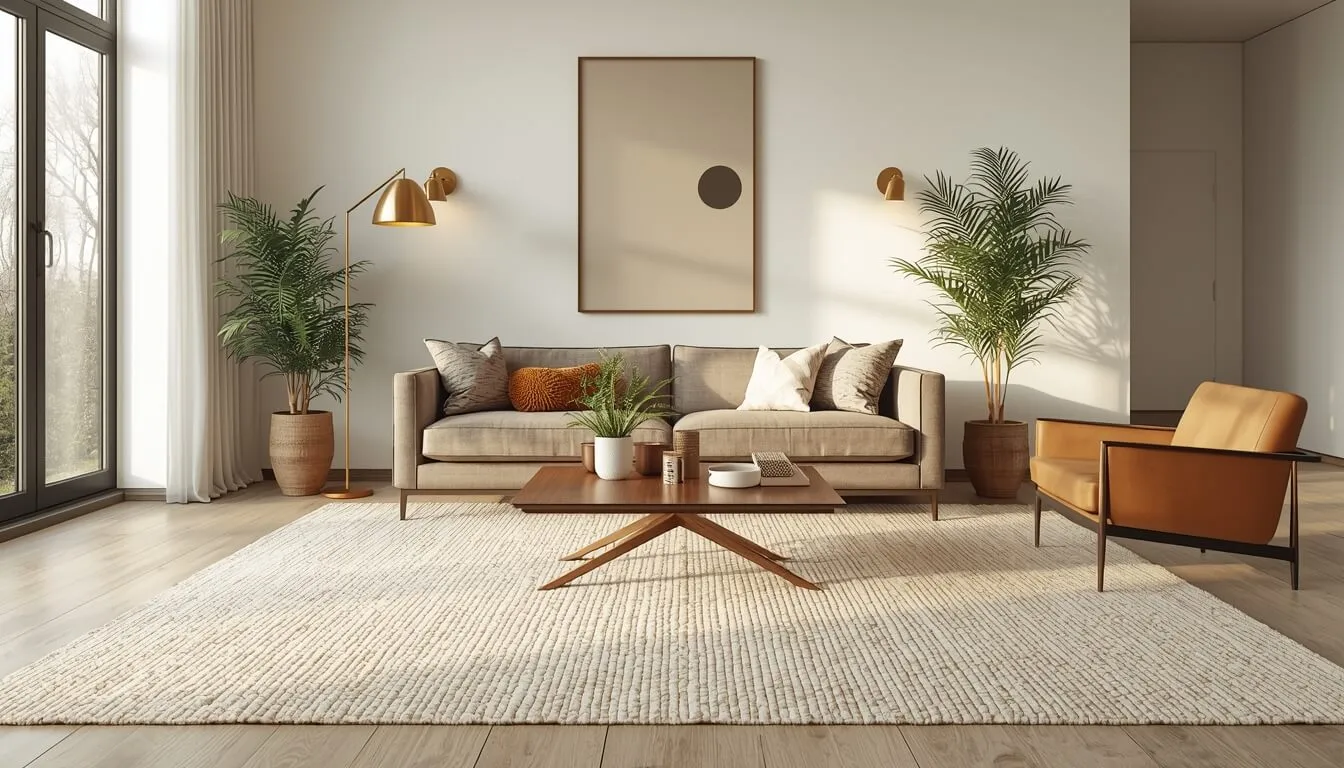
There is something incredibly peaceful about a light grey sofa. It feels airy, clean, and expensive. If you want to lean into that “Quiet Luxury” or “Scandi-British” aesthetic, a light grey sectional with ivory area rug is the ultimate combination. This is the tone-on-tone look that designers love. It is about staying within a very narrow color palette to create a sense of vast space.
Quick Stats for Light Tones:
- The Space Illusion: Using a rug and sofa within 2 shades of each other reduces visual “interruption,” making small rooms feel 15% larger to the human eye.
- Pile Depth Stat: A pile height of 0.5 inches is the “sweet spot” for ivory rugs; it is high enough to feel plush but low enough to prevent “shadow tracking” (visible footprints).
- Color Maintenance: 85% of ivory rugs sold for high-traffic areas are now treated with “silane” or “fluorocarbon” coatings to resist liquid absorption for up to 10 minutes.
Research shows that staying within two shades of the same color family can increase the “perceived size” of a room by about 15%. When the floor and the sofa are similar in “value” (brightness), the eye doesn’t stop at the edge of the furniture. The whole room feels like one continuous, flowing space. This is a great trick for smaller living rooms that feel a bit cramped.
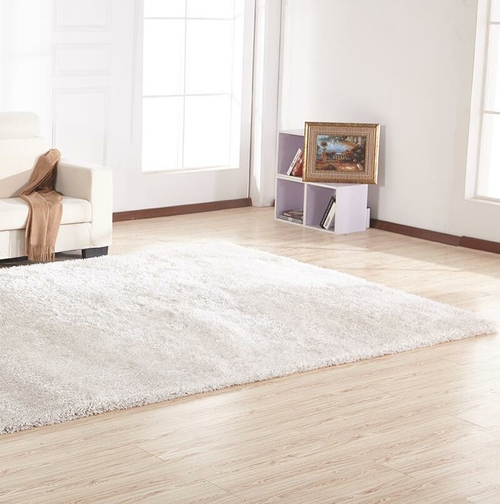
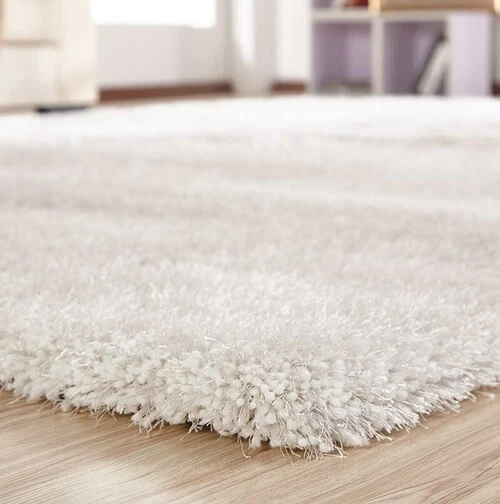
The danger with an ivory rug is, of course, the dirt. To ensure your ivory rug doesn’t look like a “grey” rug after six months, you need to look at the pile height. A pile height of 0.5 inches is the “sweet spot.” It is deep enough to feel plush and luxurious underfoot, but short enough that dirt doesn’t get “lost” in the fibers. Shag rugs might look great in photos, but they are a nightmare to vacuum. A medium-pile ivory rug is much easier to maintain.
If you are worried about the room looking too “white-washed,” use your walls to create a frame. A light grey sofa and ivory rug look stunning against “nearly neutral” walls. Think of colors like Farrow & Ball’s Pink Ground or a very soft, warm cream. These colors have just enough “dustiness” to make the ivory rug look bright and clean. It is about creating layers of soft color that build up into a cozy environment. This is how you master a light grey sectional with ivory area rug.
Add a bit of “quirk” with your rug texture. Since you aren’t using bold colors, use weave. A chunky wool loop rug in ivory adds a “hand-made” feel that balances the clean lines of a modern sectional. It feels like a giant sweater for your floor. This is the kind of room where you want to kick off your shoes and stay a while. It is the utmost in comfort, focusing on how a room feels just as much as how it looks.
The Universal Anchor: Neutral 8×10 Area Rugs for Living Room
If you are a person who likes to change your decor every season, neutrals are your best friend. Choosing neutral 8×10 area rugs for living room spaces is like buying a high-quality white shirt. You can dress it up with a velvet blazer in the winter or wear it with linen shorts in the summer. A neutral rug allows you to swap out your cushions, curtains, and art without ever having to replace the most expensive item on the floor.
Key Takeaways for Neutral Investments:
- Resale Value: Homes staged with neutral living room rugs sell 20% faster on average than those with highly saturated or “trendy” rug colors.
- Dye Processes: Solution-dyed rugs are 50% more fade-resistant than top-dyed rugs, making them essential for south-facing living rooms with heavy sun exposure.
- Visual Weight: Solid neutral rugs act as a “blank canvas,” allowing you to use patterns on 40% of other surfaces (pillows, curtains) without overwhelming the room.
There is a financial benefit to this, too. Neutral-toned homes (beiges, soft greys, creams) have a 20% higher appeal in the home staging market. If you ever plan to sell your home, a neutral rug makes the space feel “move-in ready.” It doesn’t force a personality on the buyer. Instead, it shows them the potential of the space. It is a smart investment for the long term.
When shopping for neutrals, pay attention to how the fibers are dyed. “Solution-dyed” rugs are the most durable. In this process, the color is added to the liquid polymer before the fiber is even created. This means the color goes all the way through the strand, like a carrot. “Top-dyed” rugs are more like a radish—red on the outside, white on the inside. Solution-dyed neutrals are 50% more fade-resistant, which is a must if your living room gets a lot of afternoon sun.
Don’t think that “neutral” means “plain.” You can find incredible neutral rugs with “heritage” patterns. Think of subtle William Morris-inspired florals or traditional Persian motifs rendered in shades of sand, stone, and driftwood. These patterns add “depth” to the room without adding “noise.” They hide the occasional crumb or pet hair much better than a solid-colored rug. Using neutral 8×10 area rugs for living room design is about long-term flexibility.
For a grey sectional, try a “warm” neutral rug. Since grey can sometimes feel “cool” or “blue,” a rug with hints of oatmeal or tan can bring the temperature of the room back to a comfortable level. It is about balance. If everything is cool grey, the room can feel a bit like a hospital waiting room. A warm neutral rug provides that “homely” feeling that every British living room needs.
Lastly, consider the “sheen.” Some neutral rugs, especially those made from “viscose” or “art silk,” have a very high shine. While this looks fancy in the store, it can show “water spots” and footprints very easily. For a high-traffic area with a big sectional, stick to matte finishes like wool, cotton, or dull-finish polypropylene. They look more natural and are much more forgiving of real-life use.
Expert Buying Guide: The “Muddy Paws” & Durability Test
Before you click “add to cart” on that beautiful 8×10 rug, you need to do a few checks. The first is the “Pinch Test.” If you are looking at a rug in a showroom, pinch the pile between your thumb and forefinger. If you can easily see or feel the “grid” of the rug backing, the density is too low. A low-density rug will flatten out and look “bald” within a year of sitting under a heavy sectional. You want a dense, tight pile that feels substantial.
Pro Tip for Smart Buying:
- The Density Formula: A high-quality rug should have at least 50 knots per square inch (KPSI) for hand-knotted, or a face weight of 40 oz or higher for machine-made.
- Rug Pad Friction: A felt-and-rubber rug pad increases a rug’s lifespan by 40% by absorbing the impact that would otherwise break down rug fibers against the hard floor.
- Off-Gassing: Synthetic rugs with a “Green Label Plus” certification have 90% fewer VOC emissions, which is critical for indoor air quality.
Next, you must consider the rug pad. A rug pad is not an “optional extra.” It is a necessity. A high-quality felt rug pad increases the lifespan of an 8×10 rug by roughly 40%. It acts as a shock absorber, taking the impact of your footsteps so the rug fibers don’t have to. It also creates friction, which prevents the rug from “creeping” across the floor. This ensures that your sectional stays perfectly aligned with the rug edges.
How do you handle the “dog factor”? As we say, no living room is complete without a dog. But dogs bring mud. If your dog has a favorite spot on the rug, it will eventually become discolored. Choose a rug with a “mottled” or “heathered” color—where multiple shades of yarn are woven together. This hides “track-in” dirt much better than a solid block of color.
Finally, check the “Return Policy.” An 8×10 rug is a heavy, awkward item to ship back. Colors often look different on a computer screen than they do in your actual living room under your specific lightbulbs. If possible, order a small “sample” or a 2×3 version of the rug first. See how it looks against your grey sectional and your wall paint. It is much easier to mail back a tiny rug than it is to haul an 80-pound roll back to the post office.
Putting the “Room” in Living Room
At the end of the day, your living room is for living. It is the place where you binge-watch your favorite shows, drink too much tea, and have long chats with friends. Research shows that 70% of people consider the living room the most important space in their home. The rug is the hardest-working item in that space. It takes the brunt of the foot traffic, the spills, and the weight of your furniture.
Choosing from the 8×10 area rugs for grey sectional options available is about finding that perfect intersection of “pretty” and “practical.” Don’t aim for perfection; aim for a room that feels like you. If your rug is a little bit askew, or if your “estate antique” is just a lucky find from a charity shop, embrace it. A unique living room is one that has a bit of character and a lot of heart.
Remember to “think old with new, grand with humble.” Your modern grey sectional is the “new,” and your rug can be the “old” (or at least look like it). By following the math of layout and the science of materials, you can create a foundation that will serve your home for years to come. Treat your floor with the utmost respect, and it will reward you with a cozy, beautiful space that you never want to leave. Now, go grab some painter’s tape and start measuring. Your perfect living room is just one 8×10 rug away.
Frequently Asked Questions
Not at all, provided you follow the “front legs” rule. An 8×10 rug covers exactly 80 square feet, which is the “Golden Ratio” for standard 12×18 living rooms. To ensure the room doesn’t look cramped or disjointed, make sure the rug sits at least 6 inches under the sofa. This anchors the heavy furniture and prevents the rug from looking like a tiny, lonely island in the middle of the floor.
It depends on your daily “chaos level,” but wool is the long-term authority winner. Natural wool contains lanolin, a waxy coating that makes it 30% more stain-resistant than untreated synthetic fibers. However, if you have muddy dogs or active kids, heat-set polypropylene is a great unique budget choice. It has a high “fiber memory,” meaning it won’t flatten permanently under the heavy feet of a sectional like cheaper polyester might. Comparing wool vs. synthetic 8×10 rugs for high traffic is the first step in a smart design investment.
To prevent the “cave” effect, you need a high Light Reflectance Value (LRV). Dark grey sofas have an LRV of about 10-15%, absorbing most light that hits them. You should look for modern 8×10 rugs for dark grey sofas that have an LRV of 60% or higher. Think “oatmeal,” light greige, or soft cream. This contrast makes the sofa look like a piece of art rather than a dark blob on the floor.
Yes, but you must play with texture. A light grey sectional with ivory area rug creates a “Quiet Luxury” look that can increase the perceived size of a room by 15%. To add depth, choose a rug with a 0.5-inch pile or a “high-low” weave. This creates shadows and interest that prevent the room from looking flat or sterile. It is the utmost way to achieve a high-end designer look without using loud colors.
The weight of the sofa alone isn’t enough to stop “rug creep.” You need a 1/4 inch felt-and-rubber rug pad. Using a quality pad increases the lifespan of your rug by 40% by absorbing the impact of footsteps so the fibers don’t break down against the floor. This provides the utmost protection for your hardwood and keeps your sectional perfectly aligned with the edges of your rug.