
Modern Farmhouse vs. Industrial Living Room: The 2026 Design Blueprint
As we move through 2026, the “Is modern farmhouse still in style 2026?” debate has been settled by a pivot toward Warm Minimalism. The stark, high-contrast “black and white” farmhouse look of the early 2020s has evolved into a more sophisticated, tonal approach. Today’s Modern Farmhouse favors “Mocha Mousse” and “Olive-Gray” hybrids over basic cool grays, creating a space that feels lived-in rather than staged. It is a style rooted in the Earthy Embrace, prioritizing tactile comfort and artisanal craftsmanship over mass-produced replicas that lack structural soul.
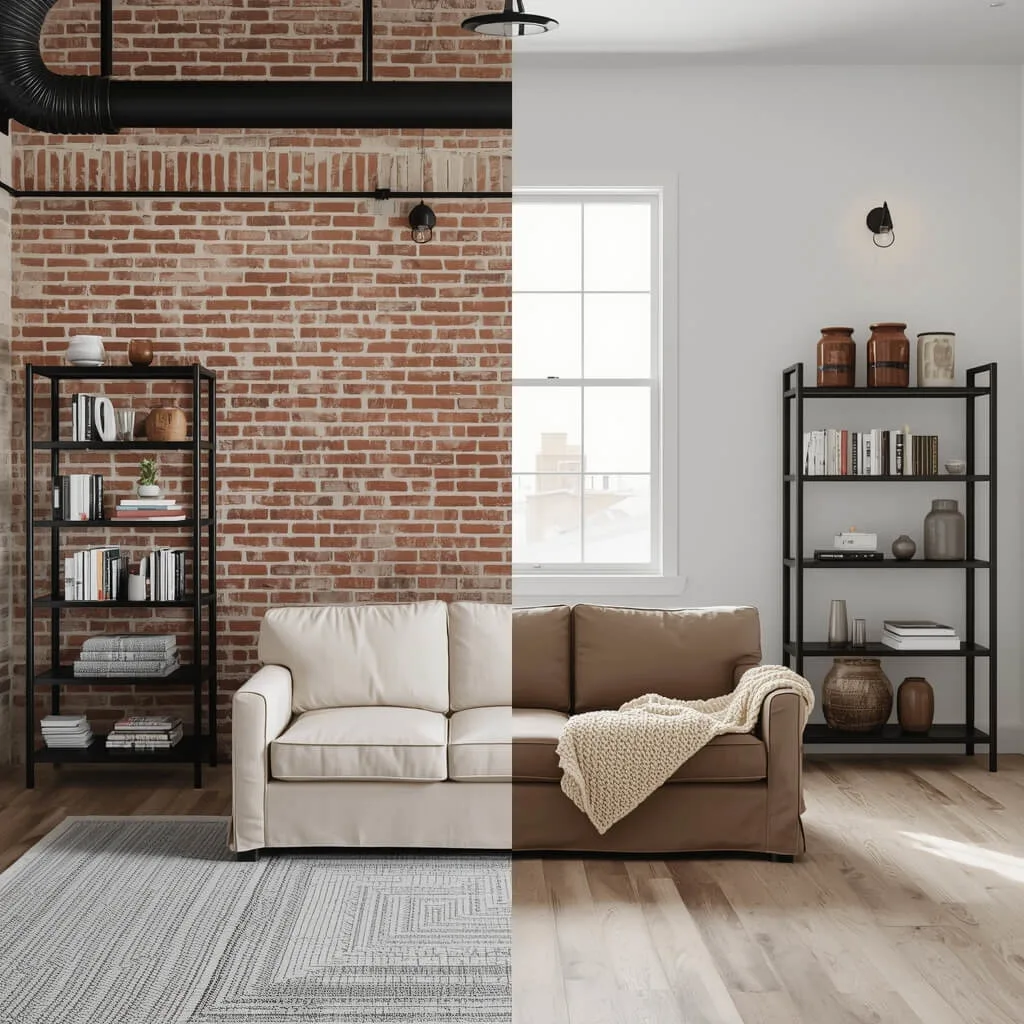
Conversely, the Industrial living room remains the hallmark of the Adaptive Reuse movement. It is a “neo-industrial” era where the coldness of factory-inspired design is humanized by terracotta tones and bio-organic textures. Where Farmhouse seeks to soften the home through textiles, Industrial seeks to reveal its “bones” through exposed structure. The choice between them dictates not just your furniture, but how your space handles acoustics and visual weight in an open-plan environment.
Furthermore, the 2026 aesthetic favors longevity over fast-furniture trends. Homeowners are increasingly looking for “generational” pieces that can survive multiple moves and style shifts. This means looking for furniture that prioritizes complex joinery and high metal gauges over mere aesthetic flair. Whether you lean toward the bright, airy feel of a farmhouse or the moody, structural vibe of an industrial loft, the focus is now on the “High-Low” design principle—mixing investment architectural pieces with accessible, high-quality decor. While these specific aesthetics define the character of a space, they are part of a broader shift toward “Warm Minimalism” and “Adaptive Reuse” that is currently shaping the most significant 2026 living room decor trends.
The Engineering of Aesthetics: Key Features of Industrial Living
Industrial design is fundamentally defined by structural honesty. In a US home, this translates to a “warehouse” feel achieved through high ceilings and the deliberate exposure of architectural guts—think HVAC ducts, I-beams, and original masonry. This style does not seek to hide the way a building works; it celebrates it. To ensure the space feels intentional, these raw elements are often framed with clean, modern lines to prevent the room from looking unfinished or cluttered.
The furniture in these spaces is utilitarian by design. Industrial style furniture for US homes focuses on oversized proportions to balance the visual hardness of concrete or brick. A signature feature is the “mechanical” element: gear-driven height adjustments on desks, oversized rivets on metal frames, or heavy-duty rolling casters on media consoles. The goal is to make the living room feel like a refined workshop where every piece has a functional history and a clear purpose.
Beyond the aesthetics, the “What are the key features of an industrial living room?” question is best answered by looking at floor plans. Industrial spaces favor “zonal” layouts rather than walled-off rooms. Large, blackened steel-framed glass partitions are often used to separate the living area from the kitchen without losing the sense of volume. This allows light to penetrate deep into the space while maintaining the “loft” atmosphere that defines the genre.
Finally, the industrial aesthetic relies on a “toughed-up” material palette. This includes cold-rolled steel, distressed leathers, and wire-brushed woods. The beauty of this style lies in its durability; it is a “low-maintenance” look where a scratch on a metal table or a scuff on a leather sofa only adds to the character of the room. This makes it an ideal choice for high-traffic living areas where “perfection” is not the goal, but “resilience” is.
Redefining the Homestead: Modern Farmhouse Living Room Decor
Modern farmhouse living room decor ideas in 2026 center on Tactile Living. It is about layering materials to create depth in an otherwise neutral environment. A stone coffee table might be paired with a plush bouclé armchair, creating a “soft-and-hard” interplay that feels curated over years. This approach moves away from the “cluttered rustic” look of the past, favoring a few high-impact pieces that provide visual interest without overwhelming the senses or creating dust traps.
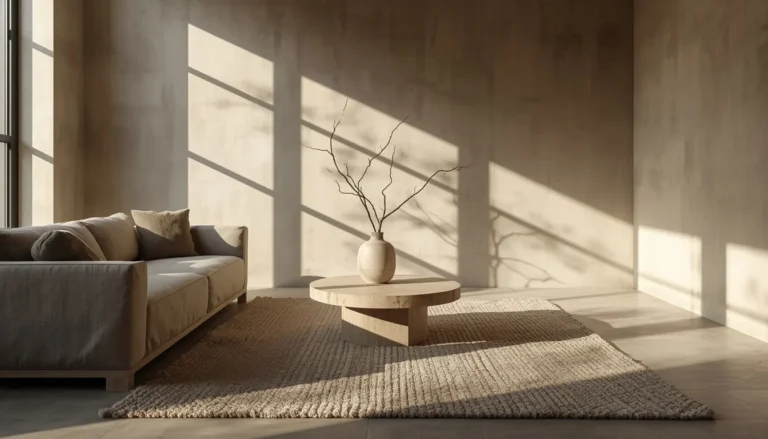
The best color palettes for rustic living rooms have moved away from “stark white” in favor of Caramelized Neutrals and Baked Clay. These colors ground the room, especially when paired with natural white oak or whitewashed timbers. By using warmer tones, the farmhouse aesthetic avoids feeling clinical or cold. The success of this style relies on the “organic layering” of textiles—mixing linen slipcovers with heavy knit throws and jute rugs to create a sanctuary-like atmosphere.
In this 2026 iteration, “farmhouse” is less about the farm and more about the “intentional homestead.” This means selecting items that have a narrative, such as handmade ceramics or locally sourced timber. It avoids the “internet jargon” of trendy decor in favor of timeless, sustainable materials. When these elements are combined, the room feels grounded and authentic, providing a sense of calm that is essential for modern high-stress lifestyles where the home is the primary recharge station.
Material Science: Evaluating Black Metal and Industrial Steel
When selecting black metal industrial bookshelves, the technical specifications determine the lifespan of the piece. In 2026, high-quality industrial furniture utilizes powder-coated steel over standard spray-painted iron. This is a critical distinction for the savvy buyer. Powder coating involves an electrostatic charge that fuses a dry polymer to the metal, creating a finish that is significantly more resistant to marring, moisture, and temperature fluctuations than traditional liquid paint.
Beyond the finish, the structural integrity of the shelving depends on the “gauge” of the steel. For a bookshelf intended to hold a heavy collection of media or decor, seek a 14-gauge to 16-gauge steel frame. The lower the gauge number, the thicker and more rigid the metal will be. This ensures that the frame will not bow or vibrate under a full load, providing a level of stability that cheaper, lightweight alternatives simply cannot match in a long-term residential setting.
The Timber Audit: Reclaimed Wood vs. Modern Milling
The cornerstone of rustic industrial interior design is the use of solid timber, but not all wood is created equal. Reclaimed wood farmhouse coffee tables often utilize species like White Oak (Janka scale: 1,360 lbf) or Heart Pine (Janka scale: 1,225 lbf). The Janka Hardness Test measures the pounds of force required to embed a steel ball into the wood; for a living room table that will face daily use, a rating of 1,000+ is essential to resist dents and deep scratches.
Reclaimed timber offers a technical advantage over modern “fast-growth” lumber because it has been naturally “kiln-dried” over decades in old barns or factories. This long-term seasoning means its moisture content is remarkably low and stable, making its resistance to warping or “checking” (splitting) far superior. When you invest in a reclaimed piece, you are buying wood that has already done its moving, ensuring the dimensions stay true regardless of the humidity in your home.
This stability is critical when combining wood with metal frames. In cheaper furniture, the wood expands and contracts at a different rate than the metal, leading to cracked joints or loose screws over time. Reclaimed wood has already reached its equilibrium with the environment, meaning the structural connection between the timber and the industrial steel legs remains tight and rattle-free for years.
Furthermore, the “patina” of reclaimed wood is a non-replicable asset. Centuries-old timber features tight grain patterns that are absent in modern commercial wood. This grain density not only looks superior but also offers better structural integrity. When selecting a coffee table, look for “circle-sawn” or “ax-hewn” marks—these are the DNA of the wood, proving its authenticity and its ability to withstand the “tough love” of a busy living room.
Comfort Engineering: Comparing Sofa Styles and Durability
Comparing farmhouse and industrial sofa styles reveals a divergence in “comfort physics.” Farmhouse sofas typically feature slipcovers made of heavy Belgian linen or high-denier cotton. These prioritize “sink-in” comfort through the use of multi-density foam cores wrapped in down-blend jackets. For 2026, look for a Martindale rub count of 20,000 to 30,000 for the fabric. This ensures the sofa can handle heavy domestic use and frequent washing without the fibers thinning or pilling.
Industrial sofas, by contrast, often lean toward “Aged Leather” in cognac, tobacco, or charcoal tones. Leather is the ultimate “tough love” material; it is naturally puncture-resistant and develops a patina that improves with age. Top-grain aniline leathers are the gold standard for an industrial living room, offering a soft hand-feel while maintaining the raw, natural markings of the hide. While less “cushy” than a farmhouse sofa, the leather industrial option offers a firm, supportive seat that holds its shape for decades.
The internal frame construction is the final piece of the durability puzzle. High-end sofas in both categories should utilize kiln-dried hardwood frames with “eight-way hand-tied” springs. This traditional method of suspension ensures that weight is distributed evenly across the frame, preventing the “sag” often seen in cheaper S-spring (sinuous) sofas after just a few years. When the frame is solid, a farmhouse sofa can simply be re-covered, and an industrial leather sofa can be re-conditioned, extending the life of the investment.
Lumens and Kelvins: The Physics of Lighting a Hybrid Space
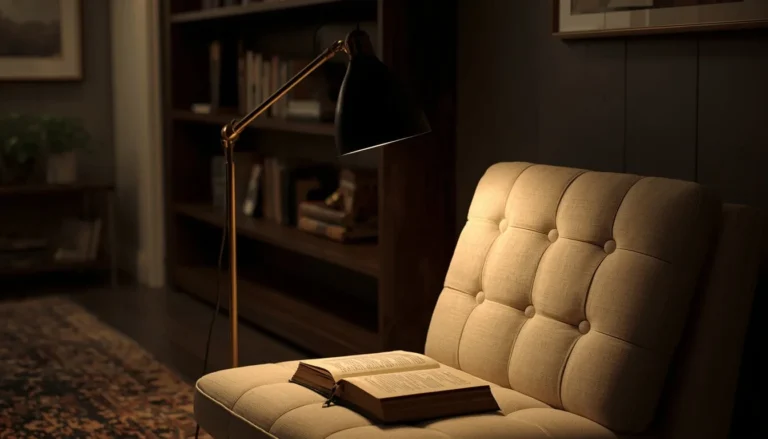
Lighting acts as “functional art” in these spaces, and mastering the look requires an understanding of the Kelvin (K) scale. Traditional Edison bulbs, a staple of industrial design, sit between 1800K and 2400K. This creates an amber, nostalgic atmosphere that mimics the glow of firelight. This warm spectrum is perfect for highlighting the textures of brick and metal, but it requires supplemental “task lighting” if you plan on working or reading in the space.
Modern Farmhouse lighting usually targets the 2700K to 3000K range. This “Warm White” spectrum is bright enough for daily activities but remains soft enough to avoid the clinical feel of higher Kelvin bulbs. Gooseneck lamps and oversized ceramic pendants are common farmhouse choices that help wash the room in even, inviting light. In 2026, the use of “Smart” Edison LEDs allows you to bridge these styles by adjusting the Kelvin temperature based on the time of day, ensuring the light always complements the mood.
The Hybrid Blueprint: Merging Farmhouse and Industrial Decor
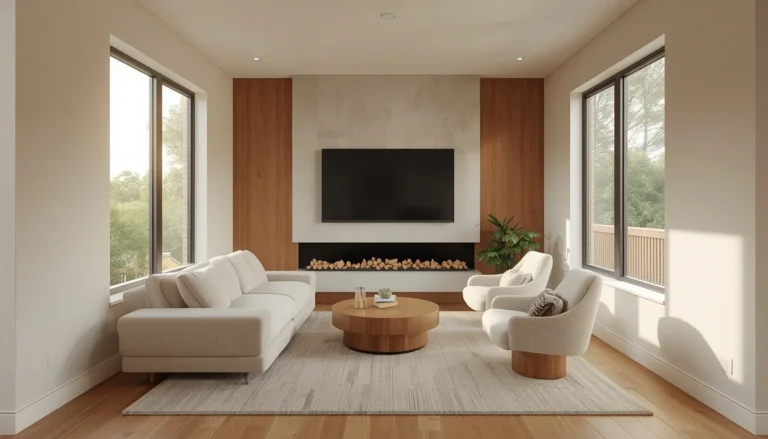
Many homeowners struggle with the “either/or” choice, leading to the rise of Rustic Industrial—a hybrid that bridges the two. To successfully learn how to combine modern farmhouse and industrial decor, apply the 60/40 Rule. Start by selecting a “Soft” base for 60% of the room—this usually means using Modern Farmhouse for your large-scale items like sofas, rugs, and wall colors. This ensures the room feels bright and inviting rather than overly heavy or dark.
Introduce the “Industrial” edge through the remaining 40% of the room’s elements. Use blackened steel lighting fixtures, metal-framed bookshelves, or a coffee table with visible mechanical parts. The secret to a cohesive look is the Visual Anchor. A heavy, reclaimed wood coffee table with matte black hardware serves as the perfect bridge, unifying the soft farmhouse fabrics with the hard industrial metals in a way that feels intentional rather than accidental.
Finally, ensure that the scale of your industrial accents matches the visual weight of your farmhouse furniture. A delicate metal lamp will look out of place next to an overstuffed farmhouse sofa; instead, opt for an oversized factory pendant that can hold its own. This balance of “visual tension” is what makes the hybrid style work. By mixing the two, you create a space that is both comfortable for family life and sophisticated enough for modern entertaining, avoiding the “cookie-cutter” look of a showroom.
The Final Verdict: Resilience and Resale Value
Both Modern Farmhouse and Industrial aesthetics offer high resale value because they rely on “natural” materials that do not go out of fashion. Modern Farmhouse is the winner for those prioritizing a “calm, intentional” sanctuary. It is particularly well-suited for families who need the flexibility of washable fabrics and the psychological warmth of a light-filled space. It remains a “safe” investment that appeals to a wide range of future buyers who prioritize comfort.
Industrial is the superior choice for those who value “structural honesty” and furniture that is virtually indestructible. If you live in an urban environment or an open-concept loft, the industrial style honors the architecture in a way that farmhouse cannot. It is a bold, personal choice that rewards the homeowner with a space that feels curated, powerful, and timeless. Whichever path you choose, focusing on the technical quality of the materials ensures your living room remains a cornerstone of your home for decades.
Frequently Asked Questions
Yes, but it has evolved into “Warm Minimalism.” The 2026 iteration moves away from the stark black-and-white contrasts of the past in favor of tonal neutrals like “Mocha Mousse” and “Olive-Gray.” The focus is now on high-quality, sustainable materials and artisanal craftsmanship rather than the mass-produced “shabby chic” decor of previous years.
The defining features are structural honesty and a raw material palette. This includes exposed architectural elements like HVAC ducts, concrete flooring, and I-beams. In terms of furniture, expect oversized proportions, blackened steel frames, and “mechanical” details like visible rivets or gear-driven adjustments that emphasize utility and durability.
The most effective method is the 60/40 Rule. Use the Modern Farmhouse style for 60% of the room—focusing on large “soft” surfaces like sofas, rugs, and wall colors—to keep the space bright. Use Industrial elements for the remaining 40%, such as metal-framed shelving and factory-style lighting, to provide a “visual anchor” and structural edge.
In terms of pure material resilience, Industrial leather sofas typically win due to the puncture resistance and aging qualities of top-grain aniline leather. However, Farmhouse slipcovered sofas offer superior maintenance flexibility for families, as the high-denier linen or cotton covers can be removed and professionally cleaned or replaced, extending the life of the internal hardwood frame.
The 2026 palette favors “Caramelized Neutrals,” “Baked Clay,” and “Deep Forest Greens.” These colors provide a warmer, more grounded feel than the cool grays of the last decade. To maintain a balanced look, pair these earthy tones with natural white oak or blackened steel hardware to create a sophisticated, high-contrast environment.